
Language is often the biggest barrier standing between people and the healthcare, public services, and opportunities they need. Here is how the Sunbird AI API gives partner organisations across Uganda the tools to close this gap — translation, automatic speech recognition, text-to-speech, language identification, and Sunflower-powered text generation, all built specifically for Ugandan languages.
Here are 5 ways our partners are putting Sunbird AI technology to work for real social impact:
- A multilingual health information tool
Patients receive critical medical guidance in a language they actually understand, cutting the risk of miscommunication in moments where it matters most. Sunbird AI’s partners are closing that gap.

A nurse speaks Luganda. A patient speaks Runyankole. A critical instruction gets lost. This is not hypothetical — it is an everyday reality in Ugandan healthcare settings.
Using the translation endpoint, you can build a tool that translates clinical text from English into the patient’s language. Combine it with the text-to-speech (TTS) endpoint, and the instruction arrives as speech — accessible to patients who cannot read.
Supported languages: Luganda (lug), Acholi (ach), Runyankole (nyn), Ateso (teo), Lugbara (lgg), English (eng).
When a nurse speaks Luganda and a patient speaks Runyankole, a critical instruction can get lost. When a farmer’s question never reaches an expert, or a citizen’s complaint never reaches the office that should hear it, the cost isn’t hypothetical — it’s a missed diagnosis, a problem left unsolved, a voice that goes unheard.
2. A voice feedback system for public services
Citizens who might never have written a complaint in English are now being heard by the institutions meant to serve them.
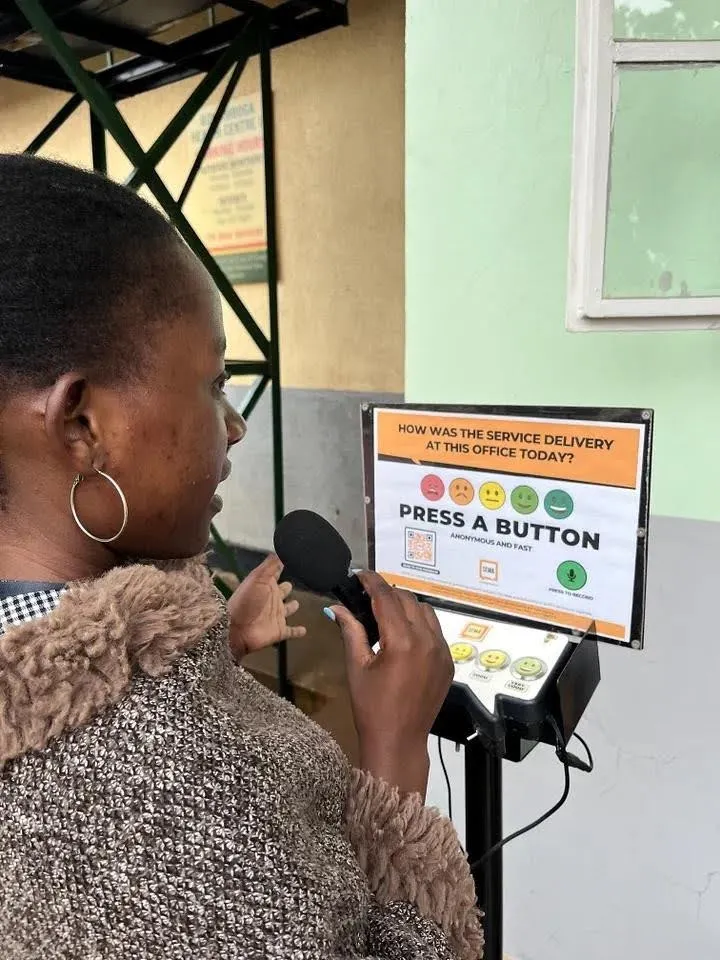
The SEMA partnership shows what becomes possible when citizens can speak rather than type. SEMA uses Sunbird AI’s Automatic Speech Recognition (ASR) endpoint to power a voice feedback interface that accepts audio in local languages, transcribes it, and, using the translation endpoint, delivers structured English-language data straight to the institutions that need it: health centres, schools, and local government offices. The audio goes in. The insight comes out and reaches the people who can act on it.
3. A multilingual agricultural advisory tool
Farmers no longer need to read or speak English to access expert advice — the same model now extends to legal aid, financial guidance, and maternal health services facing the same language gap.

The Amara Hub partnership puts a simple but powerful pipeline to work: a farmer sends a WhatsApp voice note in Acholi, Sunbird AI transcribes and translates it, an expert replies in English, Sunbird AI translates the response back, and delivers it as audio in Acholi. Amara Hub is already using this to connect farmers with expert advice in the language they speak, and the same pipeline can serve any advisory service that needs to bridge a language gap, from legal aid to financial guidance to maternal health.
4. Language identification for mixed-language inputs
Feedback and requests in any Ugandan language reach the right destination automatically, so no voice goes unheard simply because of the language it was spoken in.
Many real-world inputs arrive without a language label. A community feedback platform might receive messages in Luganda, Runyankole, Ateso, and English in the same data stream. Partners use the language identification endpoint to automatically classify each short text input, routing it to the right model without anyone having to sort it by hand.
For example, a message reading “Nkwagala nnyo” is automatically identified as Luganda, so it can be routed and translated correctly — without anyone needing to sort it by hand.
5. A Sunflower-powered assistant for 31 languages
The Impact: Community members can now ask questions and get answers in their own language, at a depth and scale no human call centre could match.
For tasks beyond translation — question answering, summarisation, text generation, multi-turn conversation — partners are turning to Sunflower 14B and 32B, which are available on Hugging Face and via the API. The models cover 31 Ugandan languages and are the current state of the art on translation for 24 of them. Partners are already using Sunflower as the model layer behind multilingual chatbots, document summarisation tools, and Q&A systems for community information services.
Join Our Cohort of Impact Partners
We’re inviting NGOs, startups, and public institutions doing this kind of work to join us. Register for an API key at api.sunbird.ai/register. Documentation is at docs.sunbird.ai. If you’re building at scale to serve more communities, reach out and let’s talk.
And if you’re already using Sunbird AI to serve your community, we want to hear your story at info@sunbird.ai
Resources
Register: api.sunbird.ai/register
Docs: docs.sunbird.ai
Sunflower Models: huggingface.co/Sunbird/Sunflower-32B