
Today we are releasing Sunflower v 2, a suite of speech and text models for 67 African languages, up from the 31 Ugandan languages our first release covered. This post describes each model, how we evaluated it, and where it stands against current open and closed systems, including where it falls short.
| Model | What it does | Results |
| Sunflower-Qwen3.8-27B | Translation, comprehension, reasoning | 46.2 chrF across 68 languages; best open model we measured |
| Sunflower-Qwen3.5-9B | Translation on smaller GPUs | 45.8 chrF, ahead of every other open model we tested |
| Sunflower-Gemma4-E2B | Offline speech-to-speech on a phone | Runs fully offline, gives low-latency speech translation. |
| SunflowerASR | Speech recognition, 51 languages | Lowest average word error rate on AfriVox-v2 and SimbaBench |
| Sunflower TTS | Speech synthesis, 20 voices and languages | Multi-speaker, consented voices |
Luganda, Acholi, Hausa, Amharic, Kinyarwanda and isiXhosa are living languages. Hundreds of millions of people trade, teach, worship and organise their communities in them. Yet modern AI barely reflects that presence, and the gap does not close with scale. A model can write fluent code and reason through a proof in English, yet fail at a simple sentence in the language someone uses to run their business.
Speech makes the gap wider. Recognition quality falls for languages with little recorded data, and falls again on real voices: regional accents, background noise, people speaking naturally rather than reading a script. For communities where voice is the natural way to use a phone, the technology often simply does not work.
This week, Sunbird joined a global effort to make AI useful in the languages and voices people actually use. Its goal is specific: within five years, the estimated 3.4 billion people whose languages are underrepresented in today’s AI should be able to use AI tools in their own language and voice. Better data and evaluation are part of that. So is something more immediate: turning language data into working models that other builders can use.
Sunflower v2 is our contribution. We concentrate on the two capabilities where the gap is largest and where better models can be put to use right away: translation and speech recognition.
In translation, Sunflower-Qwen3.8-27B scores 46.2 chrF on SALT-69, against 32.3 for the strongest other open model we tested and 38.9 and 38.0 for Claude Sonnet 4.5 and GPT-5.1. Translating into African languages, it matches Gemini 3.1 Pro across all 68 languages and leads it on the 31 Ugandan languages. Its 9B sibling comes within half a point of it at a third of the size. In speech, SunflowerASR has the lowest macro-averaged word error rate we found on both AfriVox-v2 and SimbaBench. The sections below give the full results, including the benchmarks where other systems do better.
Translation: Sunflower-Qwen3.8-27B and Sunflower-Qwen3.5-9B
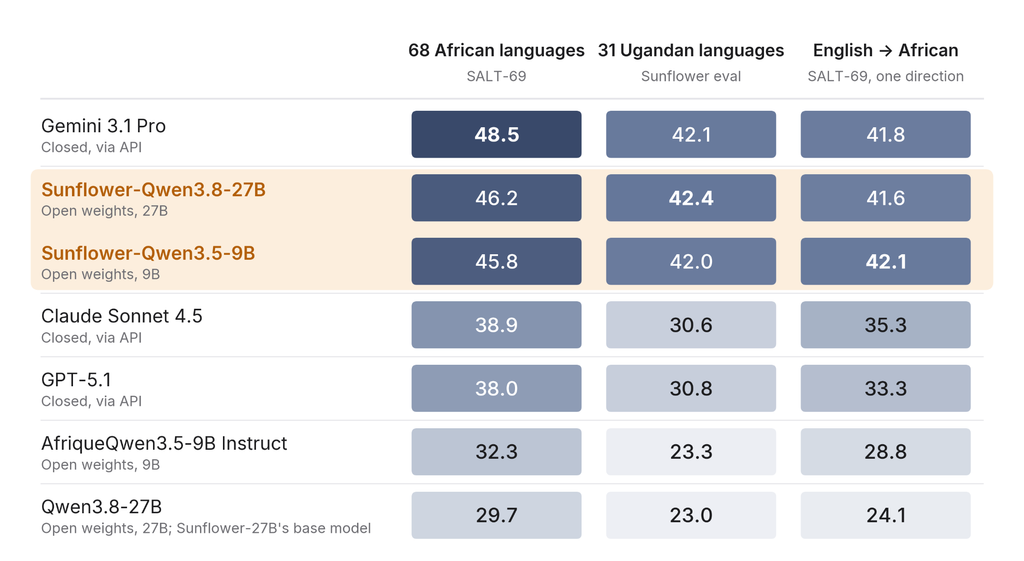
Our first release set the bar we measure against: on formal evaluation, it outperformed ChatGPT and Gemini 2.5 Pro on 24 of the 31 Ugandan languages it covered. Sunflower 2 extends that evaluation to 68 languages and adds two models, trained for translation, comprehension, and intent classification. Translation is where the gains are largest.
We measure translation with chrF, a character-level score suited to languages with rich word structure, on SALT-69: 68 African languages plus French, 100 sentences each, in both directions. Sunflower-Qwen3.8-27B scores 46.2. The strongest other open model we tested scores 32.3. Claude Sonnet 4.5 and GPT-5.1 score 38.9 and 38.0. Gemini 3.1 Pro scores higher overall, at 48.5.
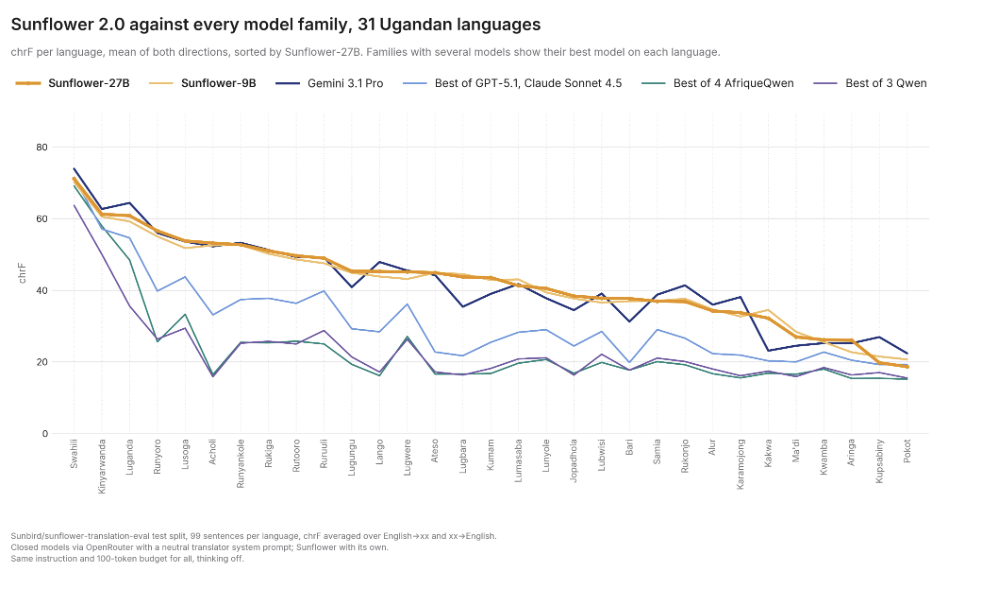
The picture changes with direction. Translating into African languages is the harder task and the one most people need, and there Sunflower matches Gemini across all 68 languages (41.6 against 41.8). On the 31 Ugandan languages, it leads Gemini by more than four points (39.2 against 34.8).
Most of this comes from training rather than the starting point. Sunflower-27B is built on Qwen 3.8-27B, which scores 29.7 on the same test. Training raises that to 46.2, and translation into African languages rises from 24.1 to 41.6. Weights and the full model card are available now.
The 9B is a translation model in its own right. At a third of the size, it scores 45.8, within half a point of the 27B, and ahead of every other open model we tested, including models three times larger. For teams deploying on a single consumer GPU, it gives up almost nothing on translation.
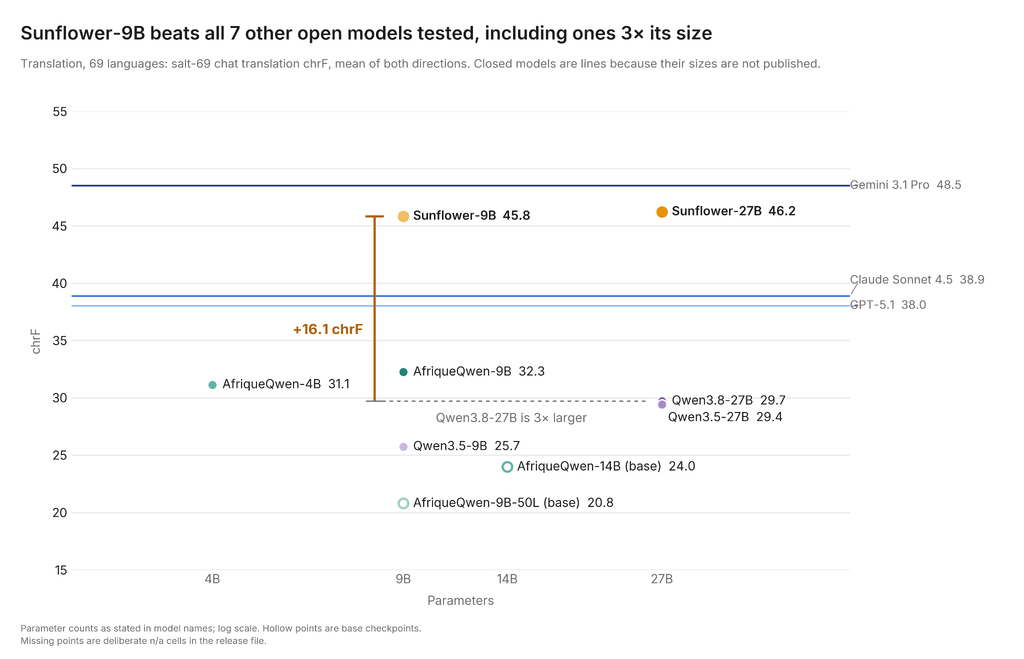
Translation quality against model size on SALT-69. Sunflower-9B scores 16.1 chrF above the strongest non-Sunflower model three times its size. Closed models appear as lines because their sizes are not published.
Beyond translation, the 27B is the best open model we measured on four of six AfroBench-Lite comprehension and reasoning tasks. It also reasons adaptively: with thinking enabled it decides for each prompt
whether to reason. On maths word problems (AfriMGSM), that lifts accuracy from 40.3 to 60.5, while translation quality stays the same.
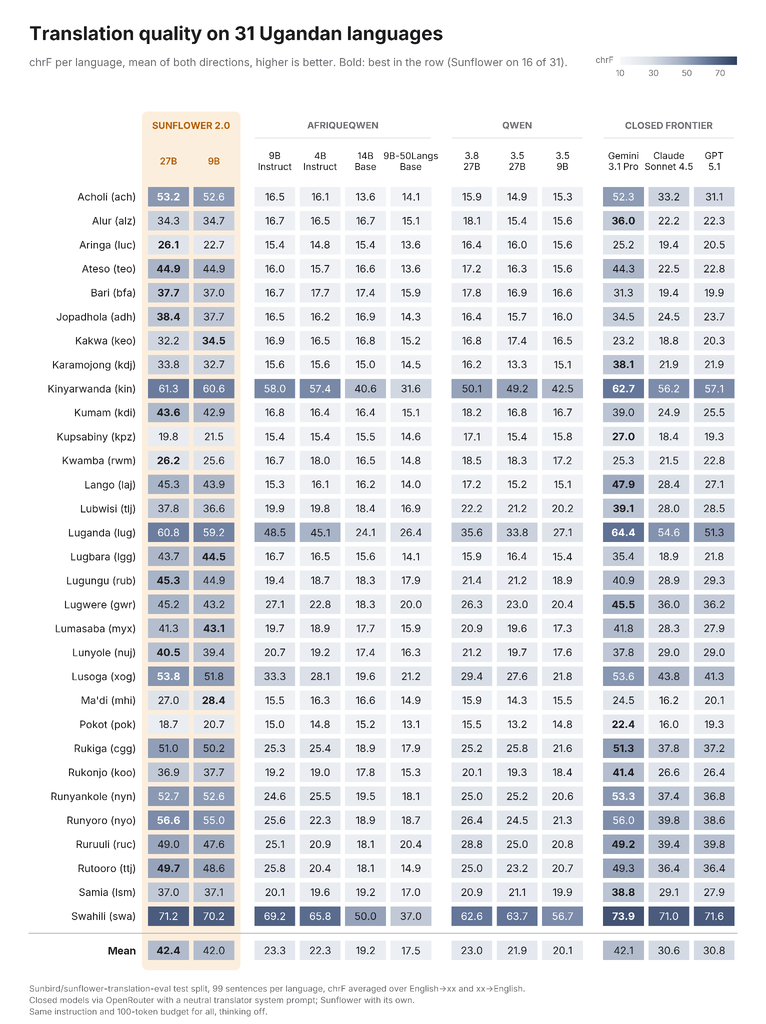
Quality is not uniform, and we would rather show the whole map than a single number. Quality tracks how much text exists for each language, and for the weakest languages output should be checked by a speaker before it is relied on.
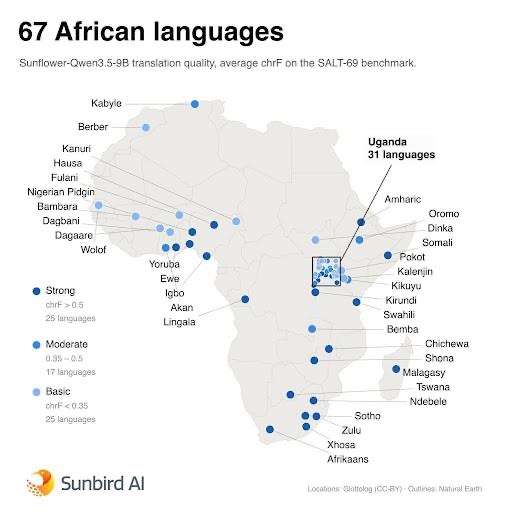
Closed models were run through their APIs with a neutral translator prompt and Sunflower with its own; all models received the same instruction and output budget. Full per-language scores are in the appendix and on the model card.
Offline by design: Sunflower-Gemma4-E2B
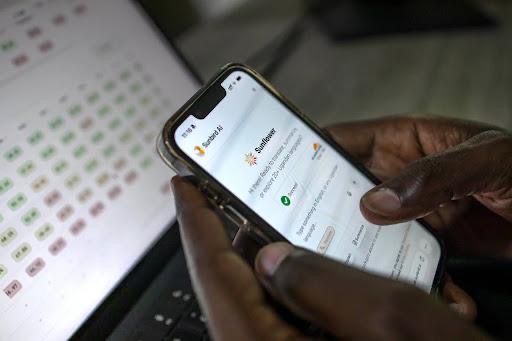
Sunflower-Gemma4-E2B is small enough to run directly on a phone, with no server. It uses Gemma 4’s native audio input: speech goes in, and the model reasons over it and answers in a single pass, with no separate transcription step.
We demonstrate it in Sunbird Tutor, a proof-of-concept classroom app running on Android in Luganda and Acholi: a spoken question goes in, a spoken answer comes back, and nothing leaves the device. On our internal evaluation set, Luganda is the strongest non-English language at about 51 chrF and Acholi follows at about 40, enough for short classroom answers.
Speech recognition: SunflowerASR
SunflowerASR is a single speech recognition model covering 51 African languages, and the most accurate published model on every benchmark we scored it against. On AfriVox-v2 and SimbaBench, the two independent benchmarks with published baselines, it has the lowest average word error rate of any system, open or closed, including Gemini, Meta’s Omnilingual ASR, Sahara v2, and Simba.
SunflowerASR was adapted from the Whisper-large-v3 model. The training corpus combines 113 dataset subsets covering 51 languages, drawn from Common Voice, African Voices, Waxal, and other public collections. After filtering, it holds 3.82 million clips, 7,412 hours of speech. All 1.55 billion parameters are then fine-tuned, with augmentation applied on the fly: additive noise drawn from a corpus of Ugandan ambient recordings, plus changes to speed and bandwidth. A final reinforcement learning pass (GRPO) trains the decoder directly against character error rate, on 15,285 clips selected for the headroom the model has on them. It helps most for the languages with the least recorded data and for audio recorded in noisy environments, and it largely removes the repetition loops Whisper falls into under acoustic stress.
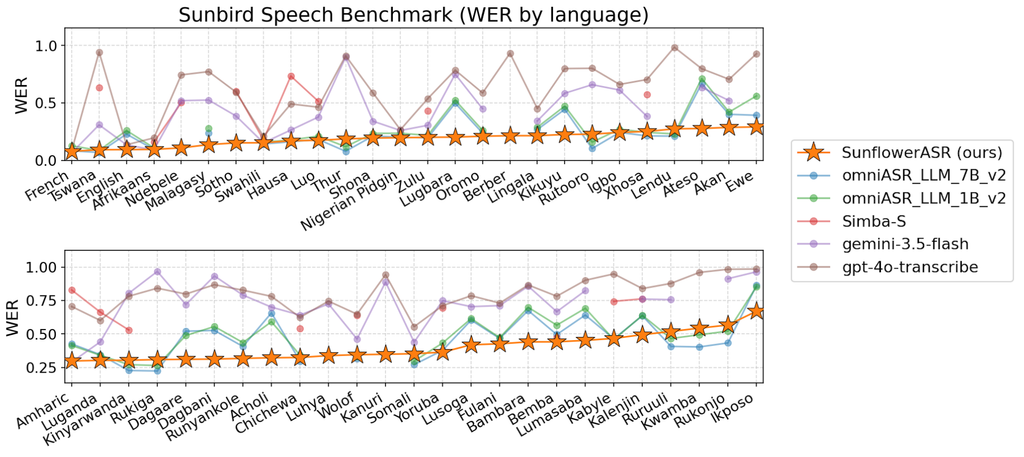
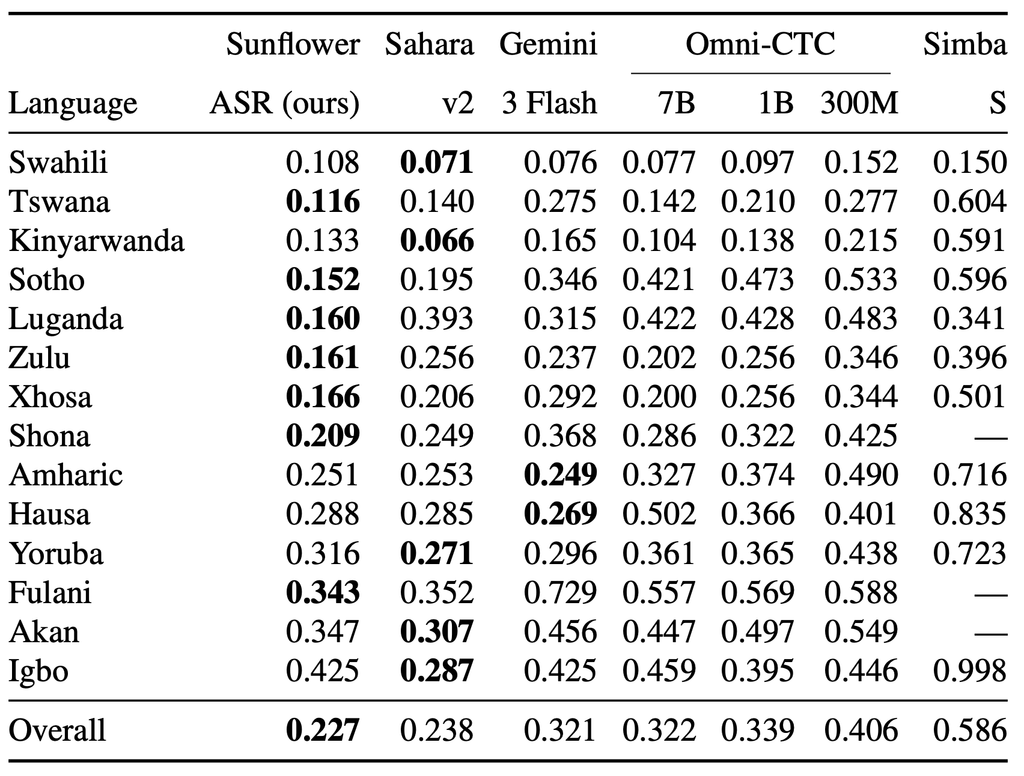
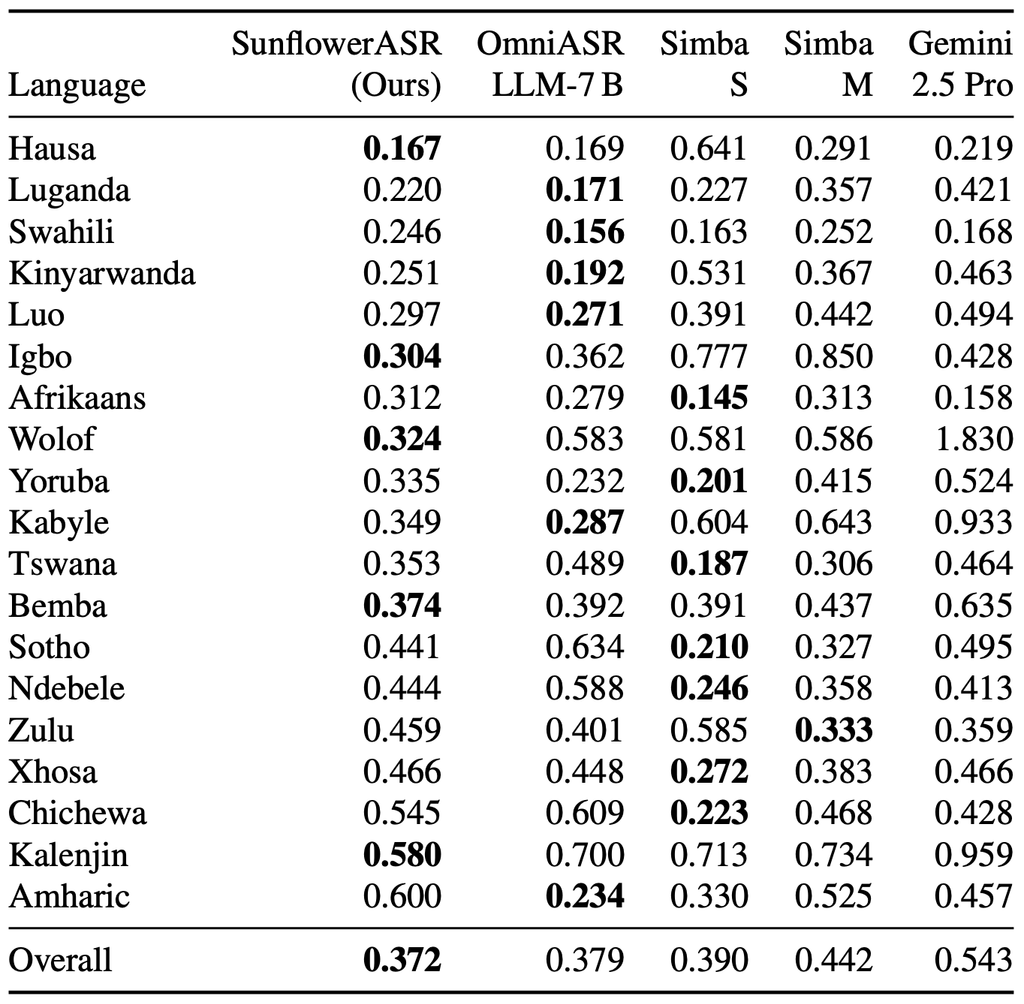
We evaluated the model on three benchmarks against Gemini, Meta’s Omnilingual ASR, and other current systems, using word error rate (lower is better). Our own Sunbird Speech Benchmark, 20,213 clips over 51 languages from 28 source corpora, is the only one of the three that covers the model’s full language range; SunflowerASR averages 29.3% on it and has the lowest error rate of any system compared on 30 of the 51 languages, against 35.3% for OmniASR-LLM-7B over the 46 languages it covers, 63.3% for Gemini 3.5 Flash and 70.9% for GPT-4o-transcribe. On AfriVox-v2, an in-the-wild benchmark of 251 hours of largely spontaneous speech across 14 languages and domains including health, finance, government and agriculture, it again has the lowest average error rate, 22.7% against 23.8% for Sahara v2, 32.1% for Gemini 3 Flash and 32.2% for the 7B Omnilingual CTC model, and it is best on 7 of the 14 languages; the largest margin is on Luganda, 16.0% against 31.5% for the next best system. On SimbaBench (19 languages) it has the lowest average error rate once more, 37.2% against 37.9% for OmniASR-LLM-7B, 39.0% for Simba S, 44.2% for Simba M, and 54.3% for Gemini 2.5 Pro.
Afrivox-v2 Benchmark
SimbaBench
Speech synthesis: Sunflower TTS
Our text-to-speech model produces natural speech across 20 language and voice configurations. It is built on a 3-billion-parameter Llama 3 architecture and fine-tuned on Sunbird AI’s own voice recordings. One deployment serves every voice: each is selected by a speaker prefix, with no separate language setting.
Audio Samples
| Language | Text | Link |
| Luganda (lug) | Ku bbalaza n’olwokuna abasiraamu batera okusiiba. | Link |
| Runyakole (nyn) | Omuceri gurimu ebika bingi, hariho ogubarikuhinga omu Uganda Kandi hariho n’ogu barikuhinga aheeru y’ihanga Kandi ogubarikuhiinga aheeru ya Uganda nigukira kuba niguhumura gye. Kandi omwingi waaza kuguteeka, oshemereire kubanza wagutoorana ahabw’okuba niguba gurimu amabaare. | Link |
Voice quality tracks how much recorded speech exists for each language, and some voices are stronger than others. Every voice belongs to a real person who consented to its use. The model must not be used to impersonate real people, or deployed in safety-critical settings without human review.
Without a quality score, audio samples are the only evidence this section has, so they matter more here than anywhere else in the post.
Building with Sunflower
All models are available as open weights on Hugging Face and through the hosted Sunflower API. Send text to the translation API and receive it in any supported language; send audio to the speech API and receive a transcript. Teams that need control can run the weights on their own infrastructure, and teams that would rather not operate models can use the hosted service.
The models are designed to sit at the edges of larger systems. Audio can pass through SunflowerASR before search, retrieval, or another language model; text can be translated on its way into or out of an application. The application keeps working in a single language internally, while Sunflower handles speech and language at its boundaries.
Where Sunflower 2 falls short
Coverage is uneven: 19 of the 68 languages score below 35 chrF, and output in those languages needs checking by a speaker. Gemini 3.1 Pro remains stronger overall on translation, particularly into English. The 9B is tuned for translation and is not the model to use for reasoning; on AfroBench-Lite comprehension it trails AfriqueQwen-9B. On SimbaBench, other systems win more individual languages than SunflowerASR does.
Open by default
Every model in Sunflower 2, and the datasets used to train them, is published on Hugging Face under an open license, free to use, adapt, and build on.
Sunflower v2 is available now on Hugging Face
Try the Sunflower web interface
Try the Sunflower speech interface
Access the API